I don't post much here anymore because I have since left Rhode Island Public Radio (now called Ocean State Media after merging with Rhode Island PBS) and opened my own engineering company with friend and mentor Michael LeClair. You can find more info, and more/newer blog posts, at www.landrbroadcastservices.com (or just www.lrbs1.com)

Tuesday, February 24, 2026

Friday, August 15, 2014
Follow me at the Engineer's Corner
Perhaps you're wondering why there's no new posts since October 2012? Well, rest assured, I have not run out of things to talk about. Anyone who knows me knows this is not physically possible. :)
Monday, October 08, 2012
Low-Cost Sportscasting with Skype!

During my time at WEOS/WHWS (2007-11) we carried a LOT of live sportscasts, usually over 100 each academic year. As such, I got to know a lot of different ways to get audio reliably from the field back to the studios. Towards the end, one technology we started looking more at was simply using a netbook and Skype to get audio back to the studio. Can it be done? Yes it can! But there are some minor caveats - read on to see how it works...
Tuesday, August 28, 2012
What Exactly is "College Radio"?
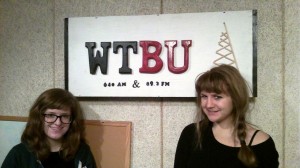 |
| WTBU of Boston University. I made that sign in 1997, it's still there, at least it was in 2010. |
- "College radio" is typically thought of as broadcasting on FM stations between 88.1 and 91.9 MHz, usually on comparatively smaller signals and with non-commercial formats. However, there's WBRU 95.5 at Brown University, KUOM "Radio K" 770AM at University of Minnesota Twin Cities, and WHWS-LP 105.7FM at Hobart & William Smith Colleges.
- "College radio" is typically thought of as being owned by a college or university, or perhaps a high school, but WFMU at 91.1 in NYC is neither owned nor affiliated with any college (it used to be owned by Upsala College, but the college went defunct in 1995). And several stations like WBRU (Brown), WVBR (Cornell), WHRB (Harvard), WMBR (MIT) and WPRB (Princeton) are affiliated with parent colleges but are owned by an independent entity, usually largely staffed by alums...and it's not a concept exclusive to Ivy League schools but a lot of Ivies happen manage their stations that way.
- "College radio" is typically thought of as having student management and airstaff but many such stations, both at colleges and not, have paid staff and community (non-student) volunteers. Some are entirely professionally staffed, like WXPN at University of Pennsylvania, KUT at University of Texas, Austin, WBUR at Boston University, and WUMB at UMass Boston.
- "College radio" is typically thought of as playing music that commercial stations will not, but WBRU and WVBR are affiliated with colleges yet tightly-formatted as modern rock stations. Come to think of it, both WBRU and WVBR actually are commercial radio stations. Advertising and all.
The bottom line here is that you can't really use the term "college radio" to refer to ownership, frequency, management style, operational style or staff makeup.
So what CAN you use "college radio" to refer to?
I say you can use "college radio" as a reference to a particular format of programming. In the sense that it's almost the absence of a format...quite literally it can refer to the "freeform" style of no format / totally random genre playing. But there is a relatively distinctive sound that most people can identify as "college radio."
I liken the concept to "public radio," which also covers a wide variety of ownerships, frequencies, management styles, etc...but nevertheless has a very distinctive sound and relatively consistent programming.
And I would go so far as to say there's a lot of value in thinking of "college radio" as a format. A format is, at its core, an idea. A concept to organize a set of values around. And what values do "college radio" espouse? How about creativity, freedom, experimentation, and learning. Those are good values, are they not?
Sunday, July 29, 2012
Radio World: InoMini 632 - Pro Features, Reasonable Price
(this article appeared in the July 25, 2012 edition of Radio World)
In May of 2010, the FCC codified an informal policy of allowing analog FM translators to rebroadcast an HD Radio multicast feed, thus bringing that programming to a (theoretically) wider audience. For many operators, this was a golden opportunity to allow greater localization to their markets via translators. For critics, it breaks some rules by effectively allowing translators to originate unique programming without counting towards the market ownership caps.
Enter the Inovonics InoMini 632. Building on a tradition of “pro” Inovonics receivers often used for OTA reception and relay, the 632 is a solid choice for that purpose. Even though it’s technically sold as a confidence monitor, meant to be used in a studio with lots of clean signal, it works well in remote applications, as I discovered.
PROFESSIONAL
The 632 is a compact, 1RU tall, 1/3-rack width box. The front has a multifunction display, controller knob with push-to-select, and a 1/8-inch headphone jack. The back has three male XLR connections: left and right balanced analog out, plus AES digital out. There’s a female F connector for RF in, a four-connector Phoenix block for status out and a pair of power jacks; the 632 is designed to be able to daisy-chain one power supply for multiple units in one rack.
The status outputs are HD loss, audio loss, signal loss and ground. HD loss is when the DQ (Digital Quotient — an iBiquity measurement of several factors inside the codec) meter drops to zero. Audio loss is determined by a user-adjustable silence sensor (1–120 seconds), and signal loss is by a user-adjustable hash mark on the RSSI (received signal strength indicator) meter. I typically set the hash mark one bar below the seemingly-most-stable signal level on the RSSI.
On the bench the 632 demonstrated the usual solid receiver performance that most HD Radio receivers have; the inherently low signal levels of HD (running from 1 to 10 percent analog power) demand quality receivers. It was comparable to my Boston Acoustics Receptor HD I had hooked up to the same antenna via a splitter.
I noticed that the brick-style power supply put out a surprising amount of noise on the FM band. I suspect it’s partly because it has hefty capacity to handle up to three 632s via the aforementioned daisy-chain method. A lower-amperage wallwart I had handy produced no audible noise effects. I don't consider the noisy power source a deal-killer; in the field, a receive antenna would normally be more than far enough away to avoid any RF interference from the power supply.
For field testing, I elected for a challenge: reliably receive KCBX-HD3 up on Broadcast Peak, a 4,100-foot mountain about 20 miles northwest of Santa Barbara, Calif.
KCBX is a Class B FM that’s 70 miles NNW on Cuesta Peak near San Luis Obispo, a hefty distance for a 5,300 watt ERP analog signal. Reduce that ERP to –14 dBc, and then add in several grandfathered high-power “Super B” stations on Broadcast Peak (34 kW, 108 kW, etc.) and a known, consistent tropo path over the Pacific Ocean from San Diego, coupled with daily external temperature swings from mid-50s to mid-80s, and you’ve got a challenge!
I had two medium-sized Scala yagi FM antennas at my disposal. One was in the compound, and thus subject to more interference from nearby stations, but it had better filtering (bandpass, with a notch to reduce a physically nearby translator on 90.9FM) and a short coaxial cable feed. The other was several hundred feet away horizontally, and several dozen feet vertically, mounted on the north side of the mountain.
The location reduced interference issues (only a bandpass filter here) and eliminated the San Diego tropo path problem, but added a lot of cable loss. Normally it needs a preamp located at the receive antenna. We used an Advanced Receiver Research gallium-arsenide FET preamp that’s wideband, very clean, and adds about +20 dB of signal. But at first I took the preamp out since they often raise the noise floor enough to swamp the inherently low-powered HD carriers.
Using the first antenna, the “compound” antenna, the signal seemed OK at first, but quickly developed significant dropout-to-silence problems. The 632’s RSSI read about 40 of 48 bars, but during silence the telemetry outputs indicated “HD loss,” implying that the RSSI was adequate, but a high noise floor was too much for a weak HD signal.
I switched to the “down the hill” antenna, sans preamp, and there was less silence but still dropouts. The RSSI was 30 of 48. During silence the telemetry read “signal loss” before the “HD loss” appeared, indicating the signal was clean but just too weak. Finally, I put the preamp back into the circuit. That seemed to do the trick! RSSI jumped to 47 of 48 bars, and reception of HD3 was suddenly rock-solid.
PERSPECTIVE
To put this in perspective, at one point I hooked up a Sony XDR-F1HD, often considered the modern-day "gold-standard" for receivers, to the same antenna systems but without the external filters and preamps. The Sony could easily pick up several distant stations that the 632 could not in that situation.
So is the Sony receiver “better?” Not necessarily! The Sony lacks the ability to lock to a specific HD multicast and it won’t hold its settings through a signal loss or power outage. The 632 will do all those things ... which are mighty important for limited-access facilities like mountaintops ... and it performs nearly as well as the Sony if you add the external filters/preamps.
There are some features I wish the 632 had, namely a composite output and actual remote control instead of just status outputs. However, such features would add to the cost and are, strictly speaking, not necessary. Doubly so on what’s designed to be an in-studio confidence monitor.
In the end, if you’re looking at using over-the-air reception of an HD signal to feed any destination, be it another transmitter or just a confidence monitor, the 632 is an excellent choice. It’s small, rugged and a pretty good receiver. Challenging reception situations may require investment in more professional antennas and filters, but for serious applications such things are recommended anyways.
Most important, the feature set finally delivers what many broadcasters have been wanting for some time and does it without breaking the bank.
Aaron Read, CBT, is the new IT/Engineering director for Rhode Island Public Radio.
 |
| The 632 in action, tuned to KCBX-HD3 while installed on Broadcast Peak. |
Either way, if a translator owner wanted to relay an HD2 or HD3 or HD-whatever station, using over-the-air reception, they had limited options: use a consumer-model receiver, trying to modify it or otherwise working around its lack of professional features; or spend a lot of money on a professional diagnostic model that might be overkill for the purpose.
Enter the Inovonics InoMini 632. Building on a tradition of “pro” Inovonics receivers often used for OTA reception and relay, the 632 is a solid choice for that purpose. Even though it’s technically sold as a confidence monitor, meant to be used in a studio with lots of clean signal, it works well in remote applications, as I discovered.
 |
| Rear panel of the 632. |
The 632 is a compact, 1RU tall, 1/3-rack width box. The front has a multifunction display, controller knob with push-to-select, and a 1/8-inch headphone jack. The back has three male XLR connections: left and right balanced analog out, plus AES digital out. There’s a female F connector for RF in, a four-connector Phoenix block for status out and a pair of power jacks; the 632 is designed to be able to daisy-chain one power supply for multiple units in one rack.
The status outputs are HD loss, audio loss, signal loss and ground. HD loss is when the DQ (Digital Quotient — an iBiquity measurement of several factors inside the codec) meter drops to zero. Audio loss is determined by a user-adjustable silence sensor (1–120 seconds), and signal loss is by a user-adjustable hash mark on the RSSI (received signal strength indicator) meter. I typically set the hash mark one bar below the seemingly-most-stable signal level on the RSSI.
On the bench the 632 demonstrated the usual solid receiver performance that most HD Radio receivers have; the inherently low signal levels of HD (running from 1 to 10 percent analog power) demand quality receivers. It was comparable to my Boston Acoustics Receptor HD I had hooked up to the same antenna via a splitter.
I noticed that the brick-style power supply put out a surprising amount of noise on the FM band. I suspect it’s partly because it has hefty capacity to handle up to three 632s via the aforementioned daisy-chain method. A lower-amperage wallwart I had handy produced no audible noise effects. I don't consider the noisy power source a deal-killer; in the field, a receive antenna would normally be more than far enough away to avoid any RF interference from the power supply.
 |
| KCBX's coverage map. Broadcast Peak is located near Solvang in the lower right. |
I had two medium-sized Scala yagi FM antennas at my disposal. One was in the compound, and thus subject to more interference from nearby stations, but it had better filtering (bandpass, with a notch to reduce a physically nearby translator on 90.9FM) and a short coaxial cable feed. The other was several hundred feet away horizontally, and several dozen feet vertically, mounted on the north side of the mountain.
The location reduced interference issues (only a bandpass filter here) and eliminated the San Diego tropo path problem, but added a lot of cable loss. Normally it needs a preamp located at the receive antenna. We used an Advanced Receiver Research gallium-arsenide FET preamp that’s wideband, very clean, and adds about +20 dB of signal. But at first I took the preamp out since they often raise the noise floor enough to swamp the inherently low-powered HD carriers.
Using the first antenna, the “compound” antenna, the signal seemed OK at first, but quickly developed significant dropout-to-silence problems. The 632’s RSSI read about 40 of 48 bars, but during silence the telemetry outputs indicated “HD loss,” implying that the RSSI was adequate, but a high noise floor was too much for a weak HD signal.
I switched to the “down the hill” antenna, sans preamp, and there was less silence but still dropouts. The RSSI was 30 of 48. During silence the telemetry read “signal loss” before the “HD loss” appeared, indicating the signal was clean but just too weak. Finally, I put the preamp back into the circuit. That seemed to do the trick! RSSI jumped to 47 of 48 bars, and reception of HD3 was suddenly rock-solid.
PERSPECTIVE
To put this in perspective, at one point I hooked up a Sony XDR-F1HD, often considered the modern-day "gold-standard" for receivers, to the same antenna systems but without the external filters and preamps. The Sony could easily pick up several distant stations that the 632 could not in that situation.
So is the Sony receiver “better?” Not necessarily! The Sony lacks the ability to lock to a specific HD multicast and it won’t hold its settings through a signal loss or power outage. The 632 will do all those things ... which are mighty important for limited-access facilities like mountaintops ... and it performs nearly as well as the Sony if you add the external filters/preamps.
 |
| The author on Santa Ynez Peak, CA, with Broadcast Peak about a mile in the background. |
Most important, the feature set finally delivers what many broadcasters have been wanting for some time and does it without breaking the bank.
Aaron Read, CBT, is the new IT/Engineering director for Rhode Island Public Radio.
Thursday, June 14, 2012
 |
| I izz a wickid vo-dyeland engneah!!! |
"But Aaron," you say, "don't you live in Santa Barbara, California? How ever shall you commute??"
Well, that's the thing: I don't live there as of June 2nd. As of June 13th I, and my lovely and exceptionally-tolerant wife, have moved back east. Not quite to our old stomping grounds (Boston) but pretty close. We're livin' la vida efficiency studio hotel room for a week or two while we find a new apartment near Providence.
If you're interested in the drive that took the days between the 2nd and the 13th, and also feeling a bit masochistic to indulge in my narcissism, you can check out a whole bunch of photos we took while on the road from Santa Barbara to Providence...by way of Vegas, the Grand Canyon, the Petrified Forest, the Rocky Mountains, Denver, Wichita, Salem (Indiana), Morgantown, DC, Baltimore, Philly, NYC and finally Providence.
This new job does mean my blogging will likely be somewhat less frequent, although I've got a new series that starts in the latest edition of Radio World Engineering Extra (see pg.22) so check it out!
Monday, April 16, 2012
Paid Political Ads on Non-Commerical Radio/TV
 |
| Maybe the world really IS ending in 2012 after all?? |
http://www.sfgate.com/nation/article/Public-TV-political-ads-to-get-rehearing-4058834.php
On April 12th, 2012, the Ninth Circuit Court of Appeals delivered a verdict on Minority Television Project, Inc v. FCC. And it's a doozy. Basically, the court invalidated a long-held rule that non-commercial broadcasters cannot air paid "political ads" or paid "issue ads." So now they can.
I'll pause a moment to let that sink in.
If upheld, it's potentially a game-changer, on the level of the Citizens United case, for the entire broadcasting industry. But there's a lot of questions and confusion surrounding the decision, and the consensus is that nobody really knows for sure just yet what the final impacts will be.
This article is an attempt to collate several useful facts, opinions and other tidbits of information into a centralized resource. I'll update it as we learn more going forward. Right at the outset, I'll remind everyone that IANAL: I Am Not A Lawyer and that a lot of what I'm writing about here is speculation. Informed speculation, maybe. Speculation based on facts, perhaps. But speculation nevertheless. I encourage anyone who has hard evidence or solid facts that confirm or refute any of the speculation to leave their notes in the Comments and I'll update as we go along! :)
Much, much more after the jump...
Monday, March 12, 2012
You Wanna Sell HD Radio Receivers?
 |
| Yes, it's an awful pun...but guinea pigs do "wheek". |
This is a vicious cycle and it's especially true in cars...where the bulk of high-value radio listening takes place. Auto manufacturers (OEM's) don't care because their dealers aren't reporting any consumer demand for HD Radio. And OEM's do care about companies like Microsoft and XM/Sirius who're paying those OEM's a lot of money to add products like Sync and satellite radio to the dashboard.
Radio doesn't have a single, unifying organization that can afford to step up and pay auto OEM's the big bucks to demand HD Radio's be offered as standard equipment in cars, as opposed to seldom-offered "options" (and only on the high-end models at that).
So instead, the onus falls on the individual stations/clusters to do that. But how? By taking a page out of the guerrilla marketing textbook: if you can't afford to market your product, have your customers market it for you.
More after the jump!
Thursday, February 16, 2012
I am a Broadcast Engineer
I admit, the meme was getting a little stale. But hey, I didn't see any for broadcast engineers and that's just not right. So I made one myself - enjoy!
 |
| (click for a larger version) |
Monday, December 19, 2011
It's Not Selling Out - It's Buying In: Underwriting for College Radio

So, how does a station become fiscally self-sufficient?
There are two main, traditional avenues: fundraising and underwriting. Fundraising is about asking listeners to simply donate money to the station because they want to support it. Underwriting is about asking businesses (and other organizations) to donate money in exchange for something of benefit to the business - usually an on-air mention.
I won't get into fundraising here, except to say that David Caban has put together a fabulous on-line guide for how to do on-line fundraising for WRUW in Cleveland. It's specifically for WRUW but can easily be adapted. In fact, it's definitely worth shamelessly copying it for your station. I'll also mention that if you've never done it at your station, make sure you get buy-in from your campus' Alumni Relation Office, since they are also responsible for fundraising and usually take that responsibility very seriously.
Instead, I'll focus on underwriting, because while fundraising typically has so-so effectiveness for small stations in small markets...underwriting can actually work for almost any station. Why the difference? Read on to take a new look at "selling out"...
Thursday, December 08, 2011
Protecting Your College Radio Station from a Sale

As of this writing, we've seen: KUSF (University of San Francisco), KTRU (Rice University), WRVU (Vanderbilt Student Communications, at Vanderbilt University), WNAZ (Trevecca Nazarene University), WDUQ (Duquesne University), WLIU (Long Island University), and KCMP (St. Olaf College) just to name a few. And that doesn't include several colleges who LMA'd (Local Management Agreement) their college station to another entity, effectively removing students or local involvement from the station in the process.
For years, many colleges have long looked at their student radio stations as, generally, something they'd simply rather not deal with: out of sight, out of mind. That's understandable; it costs a lot to have a station, and it benefits a relatively small (if not tiny) percentage of the student body. Compared to other student activities, college radio tends to be fiendishly expensive. And unlike most other activities, a licensed station has the potential to incur substantial fiscal penalty (i.e. FCC fines) and the ability to potentially embarrass the college on a very public stage.
Regardless, for decades, most colleges kept their radio stations. Now they're selling them. What's changed?
Sunday, December 04, 2011
Cross Country in 21,000 Images!
 |
| The Beast! (pic is near Thousand Palms, CA) |
On a lark, I rigged up our laptop and a webcam on the dashboard of the truck, set to take a snapshot every 10 seconds. Then I assembled all the pics into videos - one for each day - and added subtitles about where we were at most given points.
The end result is kinda interesting, especially in a time-lapse photography sense. Check 'em out!
Day 1 - Canandaigua, NY to Effingham, IL: Winter, Winter, Winter and Construction
Day 2 - Effingham, IL to Lewisville (Dallas) TX: Why the Hell Didn't We Go Through Memphis?
Day 3 - Lewisville, TX to Van Horn, TX: It's Flat, and Empty, but the Steak is Delicious
Day 4 - Van Horn, TX to Glendale (Phoenix) AZ: Is it the Heat that Makes Pretty Sunsets?
Day 5 - Glendale, AZ to Santa Barbara, CA: Crossin' the Mojave
 |
| Map showing daily start/end points of the trip. We spent a day in Lewisville resting and visiting my wife's parents, too. |
Thursday, December 01, 2011
A Damn Good Fundraising Video
 |
| "Here & Now" host Robin Young busking in Harvard Square T Stop |
But it ALSO means that when public radio decides to poke fun at itself, it can work really, really well.
Case in point: today a buddy of mine at WBUR posted this hilarious fundraising video to Youtube:
A WBUR Film - A Cautionary Tale.
In it, WBUR GM Charles Kravetz finds the numbers aren't adding up, so he dispatches Bob Oakes, David Boeri, Robin Young and Meghna Chakrabarti...all are well-known reporters or hosts...out to the streets to scrounge up some cash. Oakes takes a "will report news for change" on the sidewalk approach, Chakrabarti runs the WBUR parking lot, Boeri sells some "quality merchandise" out of his coat, and poor Robin Young busks guitar...intentionally badly...in the middle of the Harvard Square subway stop (one of the busiest in the system). And some random listener recognized her, came over with a grin, and said "Robin, don't quit your day job," while dropping a dollar in the guitar case. Ouch.
The whole thing is sheer genius! It highlights some of their strongest local talent (well, Robin's national but she's certainly well-known locally, too) and does so in a way that takes well-known voices and makes them more accessible as people. All while poking fun at the system in a way that both makes you laugh and makes you feel just a little sorry for them.
Even if nobody actually donates directly because of this video. I feel pretty confident that this video is part of an overall amalgamation of reasons while someone...probably a lot of someones...will end up donating.
If your station hasn't done a video like this...why not? You've got nothing to lose and everything to gain.
Monday, November 28, 2011
Engaging Your Audience - Holiday Greeting Line and Listener Calendar Contests

- On-Air Holiday "Shout Outs" or Greetings.
- Listener Calendar Contests.
More, after the break...
Thursday, November 17, 2011
EAS and Anonymous

FEMA is responding that the system is secure enough, thank you very much.
Who's correct? Read on...
Wednesday, November 16, 2011
Out of Bounds with Tish Pearlman

On a related note, you may also be interested in reading my articles about:
More about the show, after the jump...
Monday, November 14, 2011
Play Ball! Remote Tech Options for Sportscasts
While I'm specifically talking about radio remote broadcasting options for sports, most of this info can be used for any remote broadcast. And I do recommend that for most college radio stations: don't stay hiding in the studio - get out and do a weekly live broadcast from the student center for a few hours...it's totally worth it.
Note: this is a written version of a presentation I often give at the annual fall CBI Conference.
This article is going to cover several topics surrounding remote broadcasts both on- and off-campus. Read on, after the jump...
Note: this is a written version of a presentation I often give at the annual fall CBI Conference.
This article is going to cover several topics surrounding remote broadcasts both on- and off-campus. Read on, after the jump...
Friday, November 11, 2011
EAS: Politics vs. Engineering
Was the November 9th National EAS Test a qualified success or a total failure?
Like most things in life, it kinda depends on your point of view.
First, the system itself did indeed fail during the test. The final tally will take weeks, but there are tons of anecdotal reports that most stations did receive the data tones, but did not receive proper audio. Early reports indicate that a loop of the audio (including the data tones) played over itself, delayed by several seconds. The second airing of the data tones caused many stations' EAS encoders/decoders (aka "endecs") to stop outright and mute the test audio until the "End of Message" (EOM) data tones were sent at the end of the test, 30 seconds later. Other endecs just played the whole thing, looped audio playing over the main audio like a bizarre version of "row-row-row your boat". Given the widespread nature of this effect, the thinking is that it must've happened at the national level (FEMA) somehow.
The TV side of things, including satellite TV, may have had a similar issue in play, just with different effects: namely a Lady Gaga video playing across DirecTV, for example.
There's also reports that some stations didn't get anything at all due to equipment failures at the state and local levels. Fortunately these seem relatively uncommon.
Like most things in life, it kinda depends on your point of view.
First, the system itself did indeed fail during the test. The final tally will take weeks, but there are tons of anecdotal reports that most stations did receive the data tones, but did not receive proper audio. Early reports indicate that a loop of the audio (including the data tones) played over itself, delayed by several seconds. The second airing of the data tones caused many stations' EAS encoders/decoders (aka "endecs") to stop outright and mute the test audio until the "End of Message" (EOM) data tones were sent at the end of the test, 30 seconds later. Other endecs just played the whole thing, looped audio playing over the main audio like a bizarre version of "row-row-row your boat". Given the widespread nature of this effect, the thinking is that it must've happened at the national level (FEMA) somehow.
The TV side of things, including satellite TV, may have had a similar issue in play, just with different effects: namely a Lady Gaga video playing across DirecTV, for example.
There's also reports that some stations didn't get anything at all due to equipment failures at the state and local levels. Fortunately these seem relatively uncommon.
Tuesday, November 08, 2011
The Three Lies of College Radio
 |
| Especially the Lies. |
Bashir: What I want to know is, out of all the stories you told me, which ones were true and which ones weren't?
Garak: My dear doctor...they're all true.
Bashir: Even the lies?
Garak: Especially the lies.
(I admit it, I'm an incurable Trekkie)
Much like my hairline, I'm going to go a little bald with this post: I think it's time that college radio stations stop lying to themselves. How so? Let me give you three statements I often hear about college radio that are simply just no longer true, if they ever were:
Tuesday, November 01, 2011
The Power of FM over AM
Wow. This article from the Boston Globe really brings it home.
We've all known for a few years now that AM Radio, as a medium, was slipping badly. Traditional cornerstones of AM formats...sports and talk...were losing market share, and several major AM signals were electing to simulcast on an FM station and seeing positive results. At the same time, we're also seeing a lot of traditional AM formats bypassing AM altogether and starting on FM, also with positive results.
One place near and dear to my heart where this has been playing out is Boston, where many, many years of market dominance by WEEI 850AM (sports) and WBZ 1030AM (news) are radically shifting. WBZ still has a killer signal; one of the best AM signals in the USA, actually...famous for being heard in 38 states...and able to hurl almost 100,000 watts across an AM-friendly saltwater path right into Boston. Even so, WBZ has seen increasing competition from local (and national) NPR powerhouse WBUR and, more recently, WGBH's flip to mostly-NPR-news, too.
But it's WEEI that's the most eye-opening. After two years of losing substantial market share to upstart SportsHub 98.5 (aka WBZ-FM) despite WEEI having the Red Sox games...Entercom finally killed off Mike 93.7FM and simulcast WEEI on the 93.7 signal.
We've all known for a few years now that AM Radio, as a medium, was slipping badly. Traditional cornerstones of AM formats...sports and talk...were losing market share, and several major AM signals were electing to simulcast on an FM station and seeing positive results. At the same time, we're also seeing a lot of traditional AM formats bypassing AM altogether and starting on FM, also with positive results.
One place near and dear to my heart where this has been playing out is Boston, where many, many years of market dominance by WEEI 850AM (sports) and WBZ 1030AM (news) are radically shifting. WBZ still has a killer signal; one of the best AM signals in the USA, actually...famous for being heard in 38 states...and able to hurl almost 100,000 watts across an AM-friendly saltwater path right into Boston. Even so, WBZ has seen increasing competition from local (and national) NPR powerhouse WBUR and, more recently, WGBH's flip to mostly-NPR-news, too.
But it's WEEI that's the most eye-opening. After two years of losing substantial market share to upstart SportsHub 98.5 (aka WBZ-FM) despite WEEI having the Red Sox games...Entercom finally killed off Mike 93.7FM and simulcast WEEI on the 93.7 signal.
Subscribe to:
Posts (Atom)